A discovery should change the story
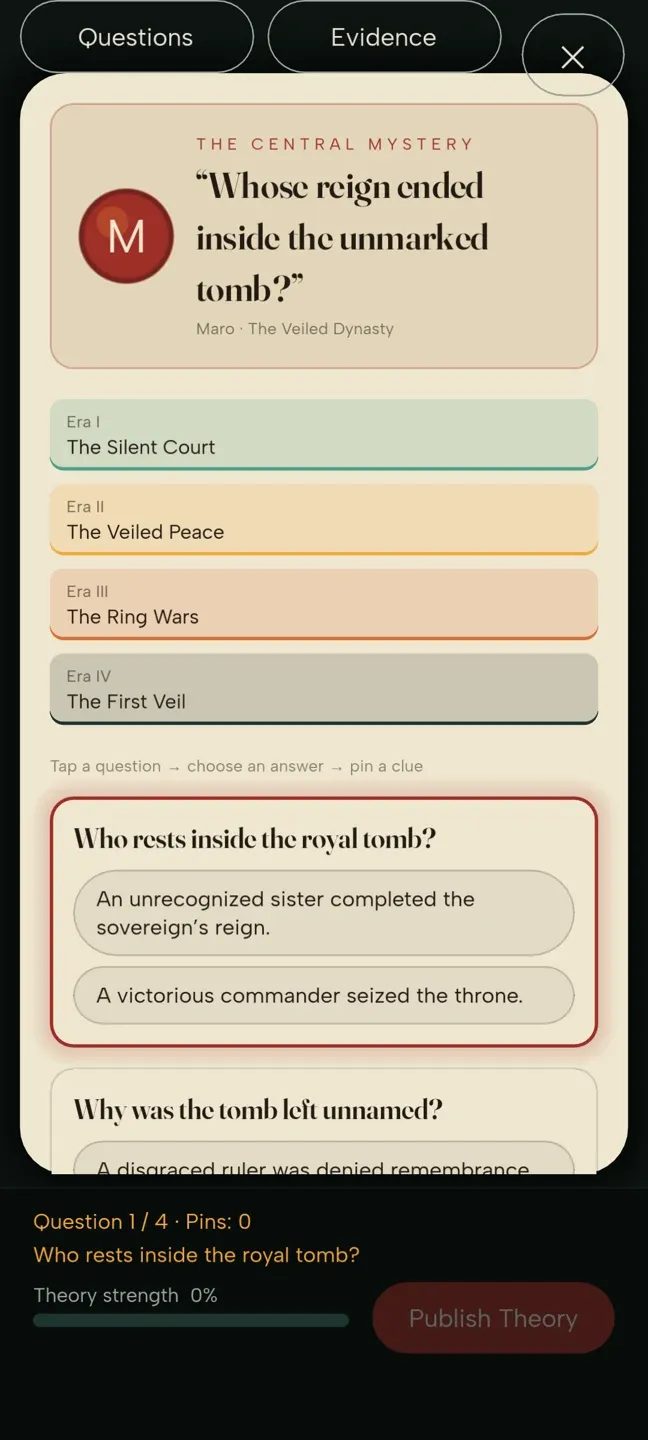
STRATUM is an archaeology game built around fictional civilizations. The player excavates artifacts, inspects evidence and reconstructs a story on a Chronicle Board. The long-term AI-native direction is to generate coherent civilizations with a hidden mystery. The current local Atlas prototype is more specific: playable expeditions, persistent progress, artifact inspection and reconstruction studies. I keep these two levels distinct so the implemented game is visible without presenting the full generative ambition as already complete.
Artifacts need to work as evidence
A beautiful object is not automatically a clue. In a mystery, an artifact has to connect to something the player can infer. STRATUM combines excavation with collection, theory and reconstruction. The repository describes canonical sprites and 3D models for finds, plus optional conservation. That gives each object a life beyond the moment it appears in the ground. The design task is to keep the interaction satisfying while ensuring that the recovered material supports the deduction.
A local game and a generation pipeline
Godot and GDScript implement the mobile client. Django, PostgreSQL and Celery support the backend and generation architecture. Current progress persists locally across discovery, excavation, theory and trials. Audio and configurable native haptics are implemented in the prototype, while networking, analytics and crash components still have stub boundaries. This is a useful way to review the project: follow the playable local loop first, then inspect each external dependency separately.
Where it stands
The project is a local prototype in active development. Physical-device acceptance, production signing, sharing and commercial integration remain open. The fictional civilizations are game content, not historical claims. The next useful milestone is a complete expedition that feels good on a real device and lets a player justify a theory using the recovered evidence. Generating more sites only helps after that basic loop is understandable and worth repeating.
Continue reading
The current portfolio, server-side AI architecture and my development workflow. Browse all projects or follow the newsletter.