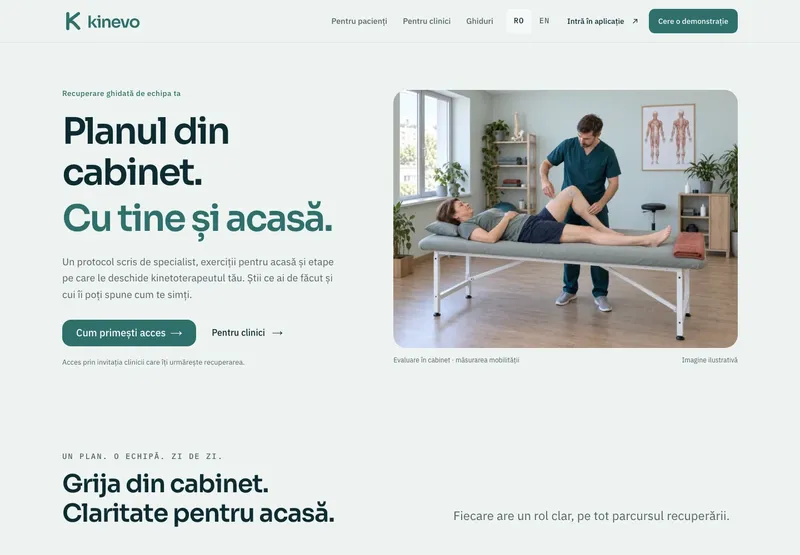
The handover is the product
Kinevo is a clinician-supervised rehabilitation and coaching platform. Its central problem is continuity: the specialist defines a protocol, the physiotherapist works with the patient, and a later handover can carry recovery into supervised training. Each step needs the right context. A library of exercise videos alone cannot describe who prescribed a movement, which stage the patient reached or who may approve progression. Those are workflow questions, and they shape the data model before they shape the dashboard.
Human approval at every clinical stage
The project has a clear invariant: the software never makes a clinical decision. A human advances every stage. That changes the meaning of automation. Reminders, records and handovers can help the team follow the process; they cannot decide that a patient is ready for the next stage. I want the interface to make this boundary visible. A recommendation, a recorded action and an approval should not look interchangeable simply because they appear on the same screen.
Why a protocol assignment is a snapshot
Protocols evolve, but a patient record must still explain what was prescribed at a particular moment. Kinevo therefore treats assignments as snapshots. If a clinician updates a reusable protocol, that should not silently rewrite a past assignment. The design preserves the context needed to reconstruct the plan for a given date. This is also a useful software pattern outside health: version a reusable template separately from the instance someone actually accepted and used.
Permissions are part of the workflow
The architecture includes clinic, patient, coach and administration surfaces. Every query is tenant-scoped, every patient-data access is audited, and patient information stays out of logs, push payloads and URLs. These are project requirements, rather than a claim of external certification. Their practical implication is that a role cannot become a global pass to every record. The API has to check the clinic context and the permission for the actual operation.
The stack and the current stage
Kinevo uses Django, React, PostgreSQL and Celery, with native mobile clients and an Astro landing. Services run on Hetzner in separate environments; running services do not establish clinical effectiveness or commercial readiness. The portfolio still presents Kinevo as in development. The next useful evidence comes from a supervised pilot that follows the complete handover, alongside the required legal review and real-device checks. This article describes the product architecture, rather than giving rehabilitation instructions.
Continue reading
The current portfolio, server-side AI architecture and my development workflow. Browse all projects or follow the newsletter.