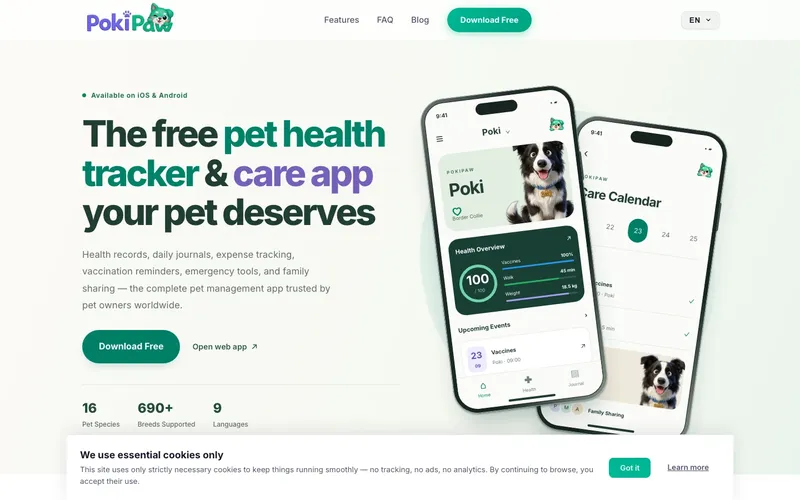
PokiPaw is a pet-care app that keeps a pet's whole life in one place: vaccinations, medications, vet visits, daily journals, expenses, and reminders. It started as a Romanian project called Carnet Animale — the paper carnet, the little health booklet every owner stuffs in a drawer and loses — and turned into a single Flutter codebase that ships to iOS, Android, Web, macOS, Linux, and Windows. It's live on the App Store and Google Play under com.trinxsolutions.pokipaw, free at the core with a Premium tier at $2.99/month.
The problem is mundane and that's exactly why it's worth solving. Owners juggle vaccine dates, dose schedules, vet bills, and "did anyone feed the dog?" across paper, calendars, and group chats. Existing apps each handle a slice — 11pets, Pet Diary, Petly — but the moment a second person in the household needs to log something, most of them fall down. That gap is the whole reason PokiPaw exists.
The competitive wedge: real-time family write access
The feature I bet on isn't health tracking; everyone has health tracking. It's that a household can co-manage a pet in real time, and every member has full write access, not read-only.
You generate a join code, a partner or housemate joins, and now both phones write to the same pet. Someone logs the evening meal, the other phone reflects it. The vet bill one person paid shows up in the shared expense view. This runs on Supabase Realtime with row-level security scoping every row to the right family, so a member can only ever touch their own household's data.
That sounds simple until you're the one reconciling two people editing the same medication schedule from two phones, possibly while one of them is on a flaky connection. The competitors I was benchmarking against were largely paid, single-user, or journaling-only. Free core plus real-time shared write access is the wedge, and it's the part of the app I'd defend hardest.
What's actually in it
The health hub is the spine: medical records, a vaccine calendar, dose-by-dose medication tracking, and a breed-specific health-scoring model covering 140+ breeds across 18+ species. Reminders fire on a three-tier schedule — 7 days, 2 days, 1 day before — through a mix of local notifications and Supabase Realtime push, so a missed vaccine isn't a single notification you can swipe away and forget.
Money is the other thing owners underestimate. PokiPaw tracks expenses with pie, bar, and trend charts built on fl_chart, and exports a PDF health report you can hand to a vet or a sitter. There's a community tab with a Google Maps finder for vets, shops, and parks (with POI caching so it isn't hammering the API), plus emergency tools.
On security: Supabase Auth with Google and Apple sign-in, a biometric lock, and screen protection so the app content doesn't leak into the OS app switcher. For something holding medical records and payment history, that's table stakes, but it's the kind of thing that's easy to skip when you're a solo dev racing to ship.
The stack
The whole app is Dart and Flutter 3, Material 3, state managed with Provider. One codebase targets all six platforms. I'll be honest about what that means in practice in the deep dive on shipping one Flutter codebase to six platforms — the short version is that "write once, run everywhere" is true for the logic and a polite fiction for the last 15% of each platform's UI.
The backend is Supabase end to end: Postgres with RLS, Storage, Auth, Realtime, and Edge Functions. Notifications go through Firebase Cloud Messaging. Observability is Sentry for crashes and PostHog for product analytics, and monetization runs on native in-app purchases. The real-time, multi-writer model leans on patterns I keep reusing — conflict handling, queueing writes when the network drops, reconciling on reconnect — which I've collected in a separate piece on offline-first sync patterns for mobile.
Two things around the app are easy to overlook. The marketing site is a separate Astro project on Vercel with a full SEO blog. And there's a standalone PokiPaw Design System — a real package with tokens, ad creatives, and a Remotion-based video renderer. That last part matters more than it sounds: app-store and social ad creatives are a recurring, fiddly cost, and wiring them into a code pipeline means I can re-render the whole set when a color or tagline changes instead of reopening a design tool eleven times.
Romanian carnet, global app
PokiPaw began as Carnet Animale, built for Romanian owners and the local habit of the paper health booklet. The bilingual EN + RO core later expanded to 7+ languages — English, Romanian, German, Spanish, French, Indonesian, and Chinese. The marketing is English-first and globally aimed now, but the product's instincts are Romanian: solve the boring, real paperwork problem first, make it pretty second.
Getting to seven languages as a solo dev is not glamorous. It's a lot of localization plumbing, and the repo carries the scars — dozens of patch scripts, agent configs, and strategy docs. This is heavily AI-assisted development, and I don't pretend otherwise; it's how one person ships something this wide. More on that working style in building 11 products as a solo founder.
Where it's at, and what's next
PokiPaw is live. Version 1.2.6+26 is in the pubspec, with multilingual release notes, freemium pricing in place — free core, Premium at $2.99/month, and Family Seats from $1.99 to $5.99/month — and it's on both stores today.
What I won't claim is traction. The marketing site says "trusted worldwide"; that's copy, not a number I'm going to quote at you. I don't have verified download, revenue, or rating figures I'd stand behind in a technical post, so I'm leaving them out. Live and used-at-scale are different claims, and conflating them is how blog posts lose your trust.
What's next is unglamorous and honest. Six platforms is a maintenance tax — each store, each OS update, each Flutter bump is surface area, and Linux and Windows in particular are more "compiles and runs" than "polished." The family-sharing sync is the part I most want to harden: more edge cases around offline writes and concurrent edits, better conflict surfacing when two people genuinely disagree about the data. And the design-system/Remotion pipeline is begging to be templated so spinning up creatives for the next product is closer to free.
If you want to see how PokiPaw fits alongside the other things I'm shipping, the full project list lives here. And if you're weighing Flutter for something that has to be everywhere at once, the six-platform write-up is the one I'd read first.