Joining should take seconds
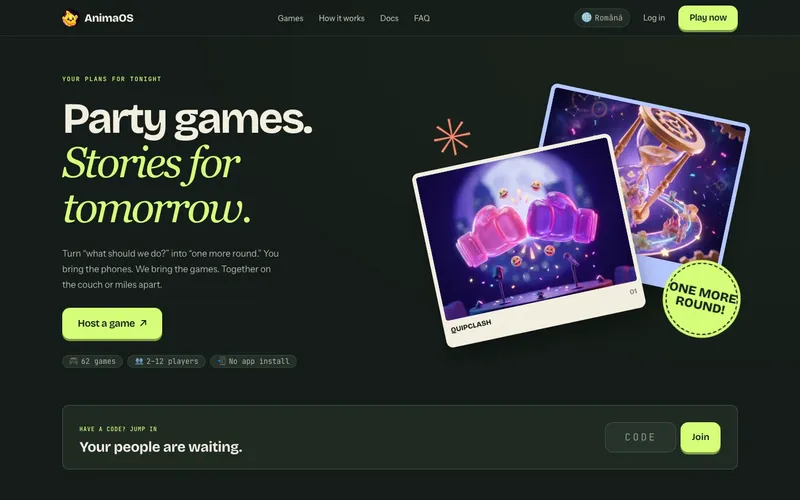
AnimaOS is a party-game platform where the phone becomes the controller. Players join through a QR code in the browser, without installing an app. That removes one of the least enjoyable parts of a group game: asking everyone to create the same setup before anything happens. The host starts the room; players bring their phones. The interesting design problem begins immediately after the join: everyone needs a clear next action, while the shared stage tells the group what is happening.
Synchronise state instead of streaming the screen
The platform uses state synchronisation, allowing each phone to mirror the shared stage. It supports people in the same room, remote players and mixed groups in one lobby. This is different from asking a distant player to watch a video of a television. The browser receives the game state and renders the relevant view. The architecture therefore has to treat reconnection, turn progression and room state as product behaviour, not merely as network plumbing. A dropped connection should not make the room unintelligible.
A declarative engine for different games
The game-definition engine separates the content and rules of a game from repeated interface work. That makes a growing catalogue easier to maintain: a new game can reuse the shared room and screen behaviours. The stack combines Node.js, WebSockets and React with Prisma, PostgreSQL and Redis. English and Romanian content are part of the product. The design opportunity is to keep the rules specific while making the familiar parts of joining, answering and seeing results consistent across the catalogue.
Where it stands
AnimaOS is listed as a live product at animaos.com. Accounts, progression and monetisation appear in the portfolio architecture, but I am not using that to claim active-user numbers or commercial performance. The most useful way to judge a party-game product is to play it with a group: how quickly everyone joins, whether the instructions survive a noisy room and whether people understand the result. AnimaOS is separate from Anima, the life-management project; the similar names refer to different products.
Continue reading
The current portfolio, server-side AI architecture and my development workflow. Browse all projects or follow the newsletter.